
“Almería, a land famous for its semi-arid and subtropical climate, locations for filming major movies and series, its beaches, renowned figures (Bisbal, Tomatito, Carlos Herrera…), the Alcazaba, its gastronomy, or Silestone, among many other features.
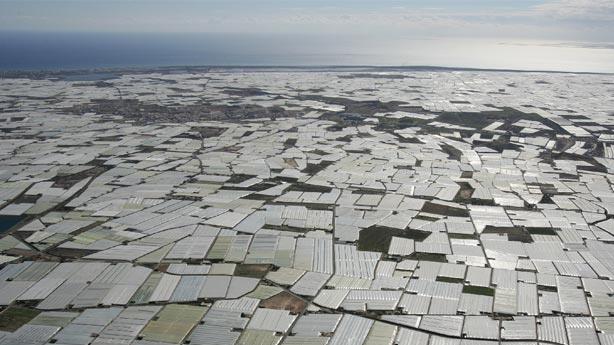
However, what distinguishes it today is its greenhouses.
It has become a Giant Orchard, exporting fruits and vegetables to various countries in Europe, Asia, and America, reaching as far as Australia. It has become the leader in fresh vegetable exports in Spain.
When did the greenhouses in Almería begin?
In the past, Almería was an arid yet paradisiacal area, without plastic walls surrounding the outskirts of towns or the transit of trucks to packaging warehouses. A quiet place with a fishing tradition, dryland crops (cereals, olives, or citrus), and a millennia-old history befitting its nation.”
“But difficult times arrived; the economy wasn’t flowing through the streets, and action needed to be taken to try to lift the production sectors of the province.
What if we harvest something?
The idea was to activate the agricultural sector, but with water scarcity, the goal was challenging, and a solution had to be found. It wasn’t until 1957 when irrigation systems were modernized, and more sustainable techniques began to be developed.
That’s when an initiative kicked off in 1963, led by the National Colonization Institute later renamed as IRYDA (Institute for Agricultural Reform and Development).
A vegetable cultivation trial was conducted, some outdoors and others under plastic covering the fields of Roquetas de Mar and its surroundings.
After confirming the efficiency of sheltered cultivation, using irrigation technology, the use of sand to neutralize the effects of salt in water, controlling soil moisture and heat, the result was accelerated plant growth.

Thus began a new era in horticultural production, developing an infrastructure that generates thousands of jobs, various industries, and new water utilization technologies.”
“The top products include tomatoes, cucumbers, bell peppers, eggplants, zucchinis, melons, and watermelons. The Raf tomato, known as ‘the black hoof of tomatoes,’ stands out among them.
Currently, the Campo de Dalías boasts the world’s largest surface area of greenhouses.
This is supported by a business structure that includes irrigation communities, nurseries, agricultural supplies, pest control and pollination, marketing (warehouses), transportation, food safety laboratories, savings banks, and agricultural schools, among others.”